
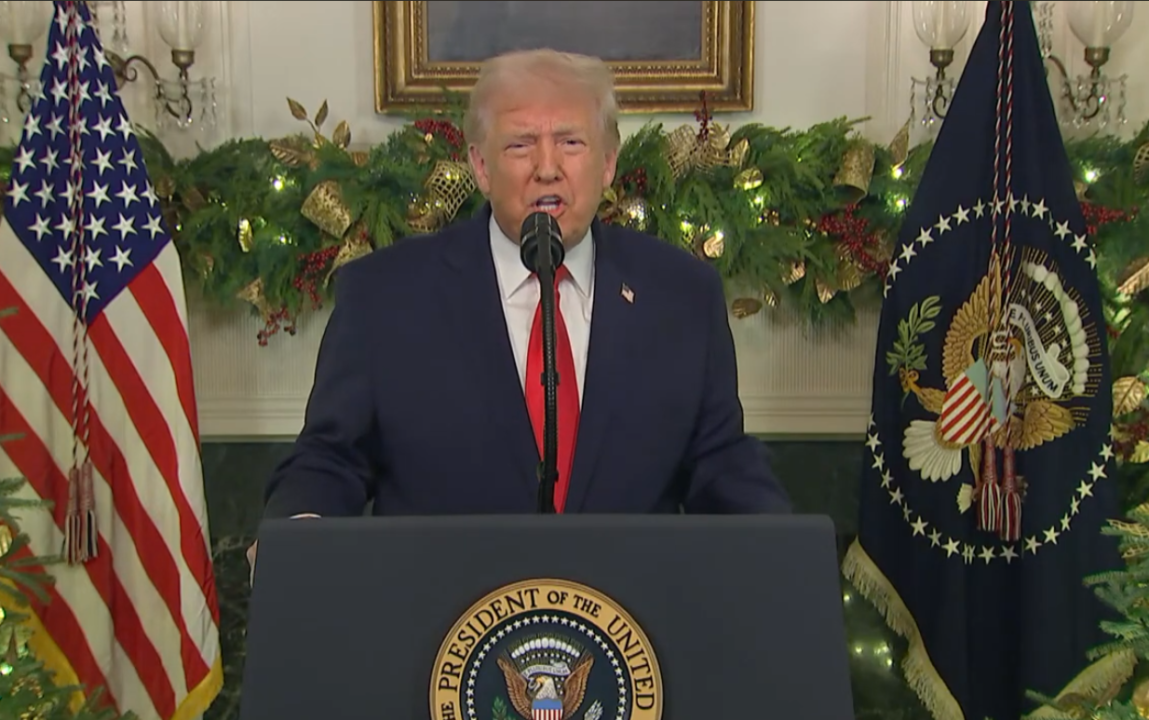

President Donald Trump used a prime-time address Wednesday night to deliver what amounted to a comprehensive status report on the nation after his first 11 months back in office. Speaking directly to the American people, Trump laid out a sweeping argument that the country has moved from chaos to control, from inflation to affordability, and from global weakness to renewed strength. The tone was not celebratory. It was declarative. This was the President’s case for what has changed, why it changed, and where he says the country is headed next.
“I Inherited a Mess”: Setting the Context
Trump opened the address by framing his presidency as a recovery mission, saying he inherited record inflation, unaffordable prices, an open border, rising crime, and a country that had lost the respect of allies and adversaries alike. He placed responsibility squarely on the Biden administration, arguing that unchecked spending, weak enforcement, and ideological governance created an affordability crisis that hit working families hardest. From the outset, Trump made clear the speech was not about intentions, but outcomes.
Border Enforcement Without New Laws
At the center of Trump’s message was immigration. The President stated that for seven consecutive months, zero illegal crossings have been permitted at the southern border, calling it a feat many said could not be accomplished without new legislation. Trump rejected that claim outright, saying border security required leadership, not excuses. He described the prior situation as an invasion, citing millions of illegal entrants, including criminals, gang members, and individuals released from foreign prisons and mental institutions.
Deportations, Cartels, and Public Safety
Trump tied border enforcement directly to public safety, saying criminal deportations have restored order in cities that had been overwhelmed by violent crime. He pointed to Washington, D.C. as an example, claiming safety levels not seen in decades. He also said his administration has decimated foreign drug cartels and reduced drugs entering the country by sea and land by 94 percent, arguing that enforcement saves lives as much as it enforces law.
Culture, Schools, and the Role of the States
The President said his administration has broken what he called the grip of “woke radicals” over public education, returning control of schools to the states. He framed this shift as a restoration of constitutional balance, not a cultural crackdown. Trump argued that education decisions should be made closer to families and communities, rather than dictated by federal bureaucracies or political activists in Washington.
Foreign Policy and American Strength
On the global stage, Trump claimed rapid progress, saying his administration has settled eight wars in ten months, eliminated Iran’s nuclear threat, ended the war in Gaza, and secured the release of hostages. He said American leadership has restored deterrence, noting that the U.S. military is now the strongest in the world and that enlistment has surged after years of decline. The underlying message was familiar: strength prevents conflict, weakness invites it.
Inflation and the Cost of Living
Trump devoted a significant portion of the address to inflation and affordability, arguing that price spikes under Biden hit nearly every aspect of daily life. He cited increases in gasoline, groceries, housing, airfare, hotels, and mortgages, then claimed those trends are now reversing. According to the President, Thanksgiving turkey prices are down 33 percent year over year, egg prices have fallen 82 percent since March, and gas prices are now below $2.50 nationally, with some states seeing prices as low as $1.99.
Wages Rising Faster Than Inflation
Beyond falling prices, Trump emphasized rising wages, particularly for blue-collar workers. He said real wages fell by roughly $3,000 under Biden but are now increasing across manufacturing, construction, and mining. Trump highlighted a key economic milestone, claiming wages are now rising faster than inflation for the first time in years. He also said more Americans are working today than at any point in history.
Jobs and the Private Sector
Trump underscored that 100 percent of job growth since he took office has occurred in the private sector rather than government. He framed this as essential to long-term prosperity, arguing that government expansion does not create wealth, but production does. The President said this trend signals a healthier economy built on real growth rather than artificial stimulus.
Tariffs and Domestic Investment
Tariffs featured prominently in Trump’s economic case. Rather than describing them as punishment, he framed tariffs as leverage, arguing they incentivize companies to build in the United States to avoid trade penalties altogether. Trump said this approach has driven record domestic investment, citing $18 trillion in commitments across manufacturing, artificial intelligence, automobiles, and energy. The message was clear: production at home strengthens national security abroad.
Tax Relief and Legislative Changes
Trump pointed to the passage of what he called the “One Big Beautiful Bill,” a package combining twelve legislative measures into a single law. Key provisions include no tax on tips, no tax on overtime, and no tax on Social Security benefits for seniors. He said many families will save between $11,000 and $20,000 annually and predicted the largest tax refund season in American history next spring, fueled by tariff revenue and economic growth.
A Direct Bonus for the Military
One of the most concrete announcements of the speech was the introduction of a $1,776 “Warrior Dividend” for more than 1.45 million U.S. service members, honoring the nation’s founding year of 1776. Trump said the checks are already being sent and credited tariff revenue and new legislation for funding the payments. He tied the move to renewed respect for the military and record enlistment numbers.
Prescription Drug Prices and Most Favored Nation Policy
Trump announced the rollout of a “Most Favored Nation” pricing model for prescription drugs, claiming negotiated price reductions of 400 to 600 percent by forcing foreign governments to pay prices comparable to what Americans have historically been charged. He said the first reductions will take effect in January through a new government website, trumprx.gov, calling the move unprecedented and long overdue.
Health Insurance and Patient Control
The President also targeted health insurance companies, criticizing the Affordable Care Act as a system designed to enrich insurers rather than patients. Trump proposed redirecting federal health-care dollars directly to individuals, allowing Americans to purchase their own coverage with more choice and lower costs. He acknowledged fierce opposition from insurers but argued the goal is patient-centered care rather than corporate-driven systems.
Energy Policy and Economic Ripple Effects
Energy policy was framed as central to inflation. Trump blamed Biden-era green energy mandates for electricity cost increases of 30 to 100 percent, costing families thousands annually. He said declaring a national energy emergency immediately lowered fuel prices and will result in 1,600 new power-generating plants within a year. Trump argued cheaper energy reduces the cost of everything else, from food to housing.
Housing, Mortgages, and Interest Rates
Trump linked housing affordability to inflation, energy costs, and immigration. He said mortgage costs increased by $15,000 annually under Democratic policies and claimed his administration has already reduced that burden by $3,000, with more relief coming. He announced plans to appoint a new Federal Reserve chair who supports significantly lower interest rates and promised aggressive housing reforms in the new year.
Immigration and Housing Supply
The President argued illegal immigration drove up housing and rental costs, citing that over 60 percent of rental market growth came from foreign migrants under the prior administration. He said taxpayer-funded housing for migrants squeezed American families out of the market. Trump claimed the country is now experiencing reverse migration for the first time in 50 years, easing pressure on housing and job availability.
Jobs for American Citizens First
Trump closed his policy case by stating that while all net job creation before his election went to foreign migrants, 100 percent of net job growth since he took office has gone to American-born citizens. He framed this as a fundamental shift in government priorities, arguing that the role of government is to serve law-abiding, hardworking Americans first.
America’s Direction Going Forward
In his closing remarks, Trump said the border is secure, inflation has been stopped, wages are rising, prices are falling, and America is respected again on the world stage. He pointed to upcoming milestones, including the World Cup, the Olympics, and the nation’s 250th anniversary, as symbols of renewed confidence. The message was unmistakable: the comeback, he said, is already underway.
WE’D LOVE TO HEAR YOUR THOUGHTS! PLEASE COMMENT BELOW.
JIMMY
Find more articles like this at steadfastandloyal.com.
h/t: Steadfast and Loyal
Leave a Comment