
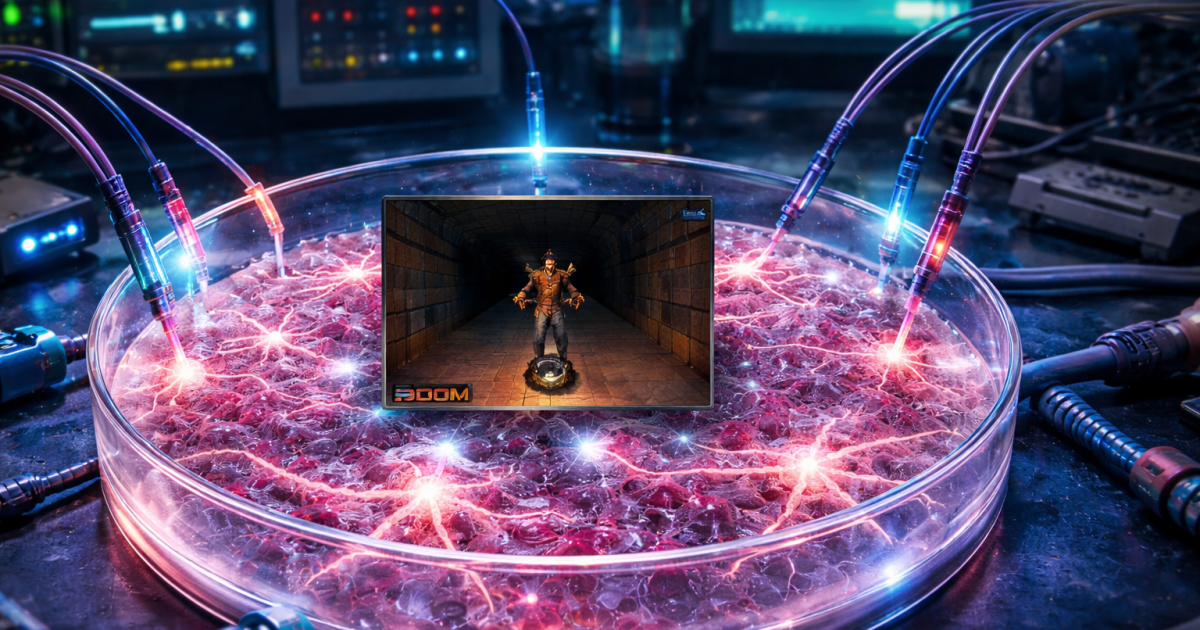

What happened in the lab
Researchers at Cortical Labs in Australia say they trained tens of thousands of lab grown human neurons to interact with the classic 1993 game Doom. The neurons sit on a microchip and receive patterns of electrical stimulation that represent the game world. When the cells fire in certain ways, the game character moves or shoots. The company calls the platform CL1 and says the neurons learned to navigate and target opponents over time.
How the experiment works
Engineers convert the visual and state data from Doom into electrical signals the neurons can detect. The cells respond with patterns of activity. Those patterns are decoded back into game actions. In other words the neurons are not conscious people. They are living biological networks that can adapt, change, and learn goal directed behaviors in real time.
Why this matters for technology
Scientists describe this as biological computing. The idea is to pair living neural tissue with electronics to solve tasks that silicon alone might handle differently. Cortical Labs previously showed similar learning with Pong. Moving up to a 3D, exploration based game like Doom is a technical step forward because the task includes navigation, targeting, and decision making in a richer environment.
Ethical and safety questions
Even with a sober tone, we need to ask questions. These are human neurons. They are not a brain with a body but they are living tissue that shows adaptive behavior. That raises ethical questions about experimentation limits, oversight, and transparency. It also raises security questions about misuse if biological systems are networked or deployed in the real world.
Where this could lead
Cortical Labs and others suggest possible uses in new kinds of artificial intelligence, brain inspired hardware, or advanced robot control. Skeptics will caution that early demonstrations look like a beginner playing a game. But the work is real and moving fast. Conservatives should watch for regulatory gaps and make sure ethical frameworks keep pace with the science.
Scientists have trained 200,000 human brain cells grown on a microchip to "play" the original Doom
“If the neurons fire in a specific pattern, Doomguy shoots. If they fire in another pattern, he moves right, and so on" pic.twitter.com/rOZEY3uFKh
— Dexerto (@Dexerto) March 1, 2026
🚨Nobody wants to hear this but it needs to be said.
> Scientists put human brain cells in a petri dish. No body. Just neurons on a chip.
> It learned to play DOOM in under a week.
> 800,000 neurons figured out how to navigate, shoot, and survive a video game without ever… https://t.co/RRsC0MwE1k
— Tuki (@TukiFromKL) March 7, 2026
WE’D LOVE TO HEAR YOUR THOUGHTS! PLEASE COMMENT BELOW.
JIMMY
Find more articles like this at steadfastandloyal.com.
Deep base for Indoc worldwide?
Scary if use implants or other
Total Control
Very 666