
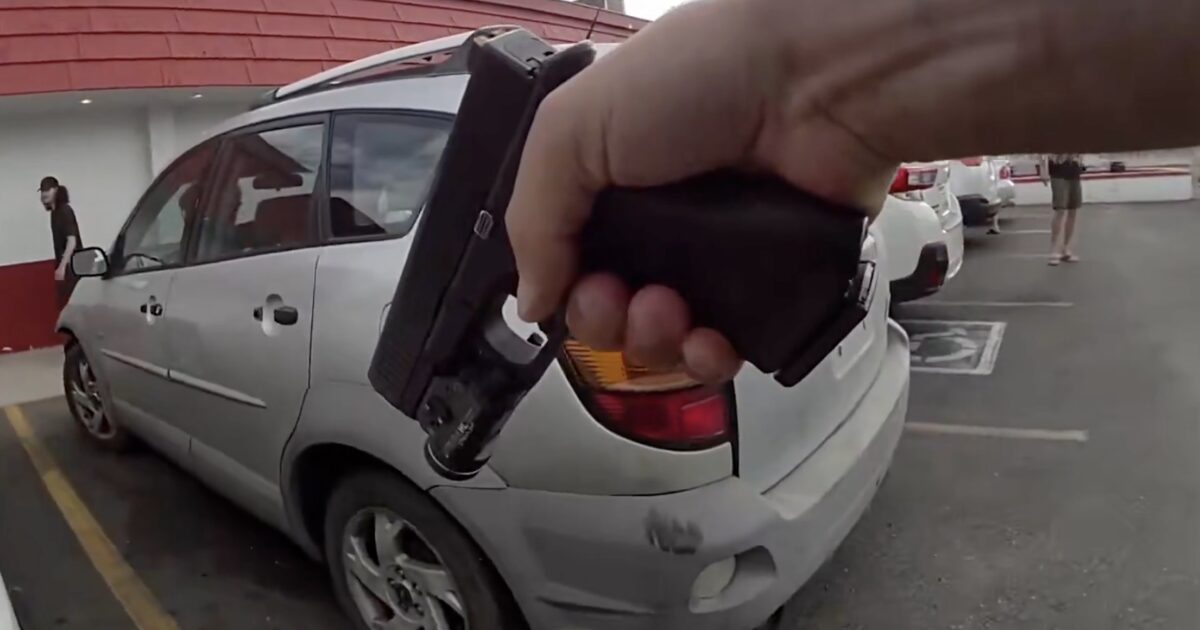

The Grand Junction Dairy Queen shooting is now the subject of a decision not to file criminal charges against the two Colorado officers who fatally shot Patti Wilson after a violent confrontation. The June 19 incident began with a dispute over a large Cherry Coke and escalated into a stabbing, a vehicle escape attempt, and gunfire in the restaurant parking lot. Authorities identified Wilson, 31, as transgender, and Wilson died at a local hospital after being struck twice and crashing into multiple vehicles. The incident left one person dead and two others hospitalized, while the elderly stabbing victim suffered a serious forearm wound. Newly released bodycam footage adds detail to the split-second decision that prosecutors later judged justified.
Wilson reportedly became agitated after being unable to pay for the drink. Colorado Times Recorder reported that Wilson refused offers from bystanders to purchase it before pulling out a knife. An older customer intervened with a chair and suffered a serious wound to the forearm. Wilson then pursued that customer out of the restaurant and tried to leave in a vehicle. Officers Zachary Diaz and Tim Long arrived after multiple witnesses called 911. That sequence matters because police were responding to a stabbing and an attempted flight, not a routine dispute over a beverage.
The Grand Junction Dairy Queen shooting began over a Cherry Coke
Diaz and Long confronted Wilson in the parking lot, according to the Mesa County Sheriff’s Office. Bodycam footage shows Wilson repeatedly maneuvering the vehicle despite commands to stop. At one point, the vehicle moved toward Diaz, forcing the officer to take cover behind another vehicle. Diaz is identified as a Marine Corps veteran, but his background was not the central question in the investigation. The key question was whether the danger facing the officers and the public was immediate enough to justify deadly force. That question had to be answered using what the officers perceived in real time.
Both officers opened fire as Wilson attempted to escape the parking lot. Wilson was struck twice but kept driving, then crashed into multiple vehicles before coming to a stop. Wilson was taken to a local hospital, where Wilson was pronounced dead. The older stabbing victim sustained serious injuries, and another person was hospitalized after the vehicle collisions. Those facts make the case more complicated than a single burst of gunfire viewed in isolation. Investigators had to consider the stabbing, the pursuit, the moving vehicle, the officer forced into cover, and the risk to people near the restaurant as one continuous event.
Why prosecutors judged the deadly force justified
In September, 21st Judicial District Attorney Dan Rubinstein determined that the officers’ use of deadly force was justified under Colorado law. KJCT reported that a nearly 40-page investigative report found both officers reasonably believed Wilson posed “an imminent threat of death or serious bodily injury” to officers and members of the public. Prosecutors also concluded that lesser force would not have been enough to neutralize the threat. That is the official legal finding, not a claim that every frame of the video looks identical from every angle. It means the review judged the officers’ perceptions against the full sequence they faced at the time.
The Grand Junction Daily Sentinel reported on November 13 that bodycam footage showed Wilson’s vehicle turning away from the officers when they began firing. That detail is at the center of the dispute, especially in debates over police use of force against moving vehicles. Prosecutors nevertheless concluded that the officers’ perceptions remained reasonable when the entire sequence was considered. The case therefore contains a tension that cannot be erased by a single video angle: the vehicle’s movement at the instant of the shots and the events that led to that instant. Both details belong in any honest account.
Police officers at the scene do not have the luxury of reviewing bodycam footage from the comfort of an office before making a split-second decision. Diaz and Long were dealing with a person authorities say had just stabbed an older customer, then got behind the wheel and continued moving despite commands. One officer had already taken cover when the vehicle moved toward him. That does not automatically settle every question about the shooting, but it explains why the district attorney focused on the total sequence rather than one isolated image. The legal review turned on whether their perception of an imminent threat was reasonable at the time.
🚨 EXCLUSIVE: Officers cleared after shooting transgender person who stabbed elderly customer at Grand Junction over a Cherry Coke
After stabbing an elderly customer and attempting to flee the Dairy Queen, Anthony Wilson, aka Patti, reversed, attempted to strike an officer with… https://t.co/XCbSuXKHR5 pic.twitter.com/ogU8T1q5Sr
— The Facts Dude 🤙🏽 (@Thefactsdude) November 17, 2026
The video dispute leaves a broader force question
The social-media post carrying the released footage describes the same basic chain of events and says Wilson reversed, tried to strike an officer, and fled before crashing. It also repeats the conclusion that the officers reasonably believed Wilson posed an imminent threat to the public. Because that post presents a favorable account of the officers’ actions, readers should distinguish its description from the separate legal finding by Rubinstein’s office. The video can add evidence without making every interpretation automatic. That distinction matters in a case involving a death, a stabbing victim, and a policy question about vehicles.
What remains unsettled in the public debate is how people interpret the vehicle’s turn away from officers at the moment of the shots, weighed against the earlier movement toward Diaz and the continuing attempt to flee. The prosecutors’ conclusion was that the officers’ perceptions were reasonable in context, even with that later video detail. One Colorado, a local LGBTQIA+ advocacy group, has highlighted the shooting and policies involving police use of force toward moving vehicles. That broader policy discussion is separate from the criminal ruling and should begin with the full timeline. The elderly customer still endured a serious knife injury, another person went to the hospital, and Wilson died after the confrontation. The clearest account acknowledges every part of the sequence without pretending hindsight is the same as being there.
WE’D LOVE TO HEAR YOUR THOUGHTS! PLEASE COMMENT BELOW.
Find more articles like this at beardsofliberty.com.
Leave a Comment