
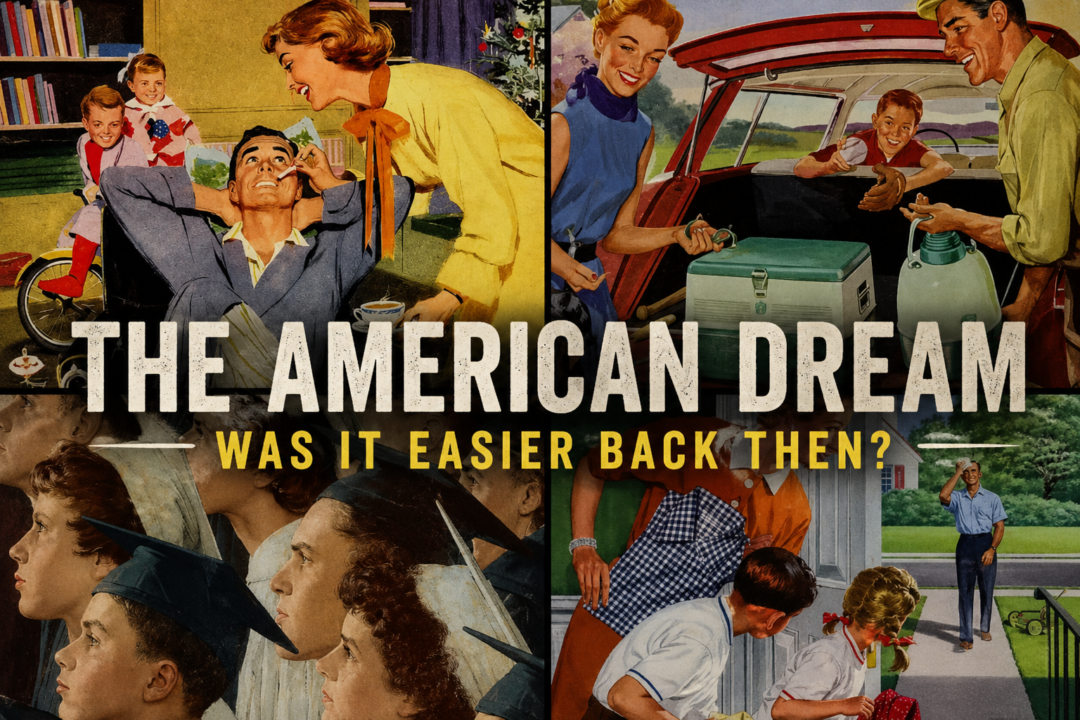

I came across a John Stossel video the other day that stopped me for a minute. He was taking on one of those claims we’ve all heard a thousand times by now: Baby Boomers had it easy. Dad could work one job, buy a house and a car, raise a family and maybe even put the kids through college, while today’s young adults can barely afford a starter home no matter how hard they work. Stossel’s basic response was: That’s largely a myth.
I’ll admit something right up front. I’ve mouthed some of those same words myself — or at least nodded along with them.
In fact, I’ve used that very idea while trying to understand why socialism is gaining traction among younger Americans. On another site I write for, Conservative Counterpoint, I’ve argued that conservatives shouldn’t simply mock young people attracted to democratic socialism because some of the economic frustrations driving them there are real. Housing is expensive. College can leave young adults buried in debt. Starting a family can seem financially daunting. My argument wasn’t that socialism was the answer — far from it. It was that we’d better understand the problem if we expect young Americans to listen to our solution.
Then I watched this Stossel video (below).
And I started wondering: What if part of the premise I’ve been accepting isn’t actually true?
So rather than arguing with him from my chair, I started digging through the numbers. Census data. Bureau of Labor Statistics data. USDA numbers. Federal Reserve data. College costs. Housing prices. Income. Airfare. Homeownership. I wanted to know whether Stossel was cherry-picking statistics to make a good video or whether my own assumptions needed some adjusting.
Turns out, I needed to adjust them.
But Stossel does too.
The America Everyone Remembers Wasn’t Quite That America
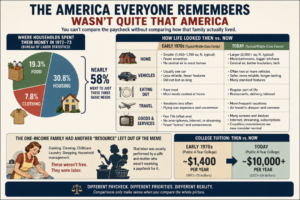
There really was a time when single-income households were far more common, homes cost much less and college tuition looks almost comically cheap by today’s standards. But comparing that family’s paycheck with today’s without comparing how that family actually lived creates a pretty distorted picture. In 1972-73, according to the Bureau of Labor Statistics, the average American household spent 19.3% of its expenditures on food, 30.8% on housing and 7.8% on clothing — nearly 58% combined. Families generally lived in smaller houses, owned fewer vehicles, ate at restaurants less frequently and flew far less often. Many things we now consider normal household expenses didn’t even exist. And the famous one-income household had another resource that gets conveniently left out of the meme: someone working at home. Cooking, cleaning, childcare, laundry and household management weren’t free. They were labor, usually performed by a wife and mother who wasn’t receiving a paycheck for it.
Stossel Is Right About Something Big: We’re Richer
This was the part that forced me to rethink my own assumptions. Real median personal income — meaning after adjusting for inflation — rose from about $28,700 in 1974 to more than $45,000 in 2024. That’s roughly a 57% increase in purchasing power. Americans also spend a dramatically smaller percentage of disposable income feeding themselves. USDA data show food consumed 17% of disposable personal income in 1960; in 2024 it was about 10.4%, with less than 5% going toward food eaten at home. Air travel is dramatically cheaper. Modern automobiles are safer, more reliable and last much longer. Houses are larger and better equipped. Air conditioning, dishwashers, multiple televisions and countless other things that were luxuries or nonexistent when Boomers were young are now ordinary. So the sweeping claim that young Americans have a lower material standard of living than their grandparents did simply doesn’t hold up. On that point, Stossel wins.
But Gen Z Isn’t Imagining the Housing Problem
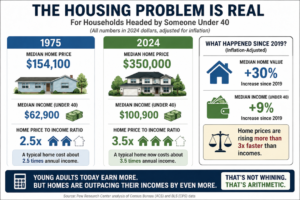
Here’s where Stossel’s argument needs its own reality check. Pew Research Center examined government data specifically for households headed by someone under 40 and adjusted everything for inflation. In 1975, the median home was worth about $154,100 in today’s dollars while median income for those younger households was $62,900. A typical house therefore cost roughly 2.5 times annual income. By 2024, young-household income had risen impressively to about $100,900 — but the median home had climbed to $350,000. That’s about 3.5 times income. Since 2019 alone, inflation-adjusted home values increased about 30% while income for under-40 households increased only 9%. So yes, today’s young adults have higher real incomes. They’re also chasing houses whose prices have risen even faster. That’s not whining. That’s arithmetic.
Yes, Today’s House Is Better — If You Can Afford It
Stossel makes a legitimate point that tends to get lost in these comparisons. A modern house isn’t the same product Americans were buying in 1970. Today’s homes are generally larger and contain better insulation, air conditioning, multiple bathrooms, modern kitchens, sophisticated electrical systems, garages and dramatically improved building standards. Part of that higher price buys more house. Fair enough. But try telling a 28-year-old couple who can’t qualify for the mortgage that their unaffordable house has really nice windows. The bigger problem is that buyers can’t necessarily choose the simple 1,400-square-foot starter house Grandpa bought. In many communities we haven’t built enough of them. Land, regulations, permitting, construction costs and local restrictions have helped make entry-level housing scarce. Stossel is right about the quality difference. Gen Z is right about the affordability problem.
College Is Even Harder to Explain Away
Higher education is where the younger generation’s argument becomes particularly strong. National Center for Education Statistics data show that public-college tuition, fees, room and board costing roughly $9,300 in 1974-75 when expressed in today’s dollars exceeded $21,000 by 2023-24. That’s after adjusting for inflation. Stossel correctly points out that far fewer Americans attended college generations ago, so the nostalgic image of Dad casually sending four kids to universities on his factory salary isn’t representative of most families. But we’ve also spent decades telling young Americans that a college degree is the ticket into the middle class while allowing the price of that ticket to explode. We can’t really blame them for noticing.
The One-Income Family Needs an Asterisk
This may be the biggest flaw in the entire Boomer-versus-Gen-Z argument. Yes, plenty of families lived on one paycheck. They weren’t financing a 2026 lifestyle with it. Houses were smaller. Families owned fewer cars. Restaurant meals were less common. Flying somewhere for vacation was unusual for many middle-class families. Mom frequently provided the childcare, cooking, cleaning and household labor that today’s two-income families often have to purchase. None of that means people were miserable. Plenty of us remember those years fondly. But saying “Dad supported five people on one paycheck” without describing how those five people actually lived is like comparing the price of a 1972 Chevy with a modern SUV without mentioning airbags, computers, air conditioning, navigation, reliability or the fact that today’s vehicle might still be running at 200,000 miles.
So Was I Wrong About Young Americans?
Partly. And I think that’s worth saying. I’ve argued before that younger Americans face economic conditions that help explain why some of them are becoming receptive to socialism. I still believe that. Housing affordability is a genuine problem. College costs are a genuine problem. Healthcare and childcare can be crushing expenses. Where I’d modify my argument after looking more closely at the data is the idea that younger Americans are simply poorer than previous generations or that Boomers universally enjoyed some economic paradise that disappeared. The evidence doesn’t support that. Young Americans have substantially higher material living standards in countless ways. The problem is more specific — and perhaps more interesting. America became much richer while some of the particular things young people associate with becoming economically independent became harder to buy.
And That Actually Matters to the Socialism Debate
This changes the way I think conservatives should talk about socialism too. We shouldn’t tell a generation enjoying historically high material living standards that capitalism has failed them. The evidence for that simply isn’t there. But we also shouldn’t wave an iPhone in front of a 29-year-old who can’t afford a starter home and declare victory for capitalism. If homeownership, education, healthcare and starting a family feel increasingly out of reach, politicians promising government solutions are going to find an audience. The conservative response shouldn’t be pretending those problems don’t exist. It should be explaining why they exist and offering market-based ways to fix them — more housing supply, fewer barriers to construction, alternatives to outrageously expensive four-year degrees, more competition in healthcare and an economy where ordinary people can build wealth through ownership and work.
Final Thoughts
I started watching Stossel expecting to find the holes in his argument. Instead, I found a few holes in mine. That’s not a bad thing. It’s what we’re supposed to do when the facts don’t fit perfectly inside something we already believe. The Internet wants a generational cage match where Boomers destroyed America and Gen Z can’t afford anything, or where spoiled young people complain from $1,000 phones about how terrible capitalism is. Neither story survives the numbers. Your grandfather didn’t have DoorDash, an iPhone, a 70-inch television, $300 flights across the country or a car that could routinely run 200,000 miles. But there’s a decent chance he had an easier path to buying the modest house underneath that television. Both sides should probably admit that. America hasn’t become poorer. Quite the opposite. The real question is why, in a country that has become this much richer, housing and education — two of the traditional entry points into the American Dream — have become so expensive for the generation trying to enter it. That’s a much better question than arguing over which generation had it worse.
WE’D LOVE TO HEAR YOUR THOUGHTS! PLEASE COMMENT BELOW.
JIMMY
h/t: Steadfast and Loyal
Leave a Comment